Why a Room’s First View Shapes Its Whole Impression
Room sightlines show how an entrance directs attention. Learn to spot a room’s visual focal point and understand its first impression without moving furniture.
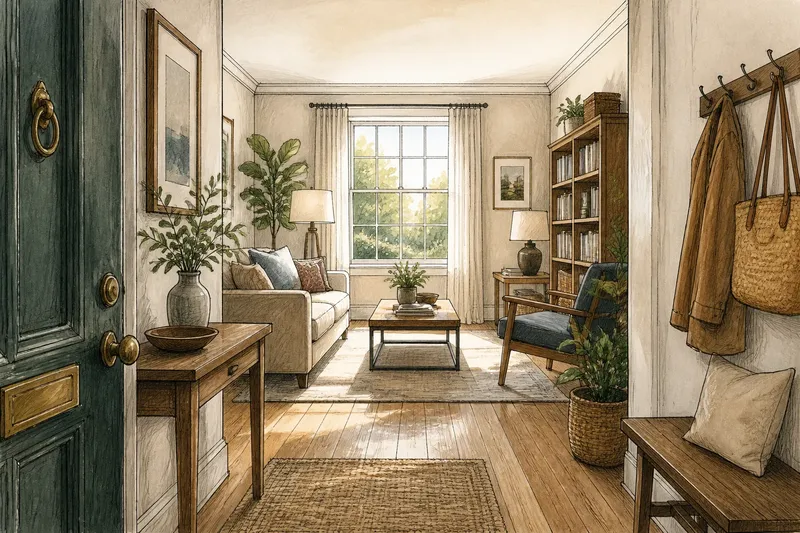
You open the front door and, before taking a step, notice the bright window at the far end of the living room. The sofa, bookcase, and lamp are there too, but the window claims your attention first. That quick glance is a room’s first view: the arrangement of shapes, light, and open space that greets someone from a particular entrance.
Room sightlines describe what can be seen from a standing or seated position, and what catches the eye along that view. They help explain why a room can feel calm, busy, welcoming, or oddly unfinished before anyone has examined its details. You do not need to rearrange furniture to understand the effect. A week of brief, deliberate observations can reveal what the entrance emphasizes and why.
Room sightlines begin at the threshold
A sightline is the visual path from one place to another. In a home, it may run from the front door to a window, from a hallway into a kitchen, or from a bedroom doorway toward a dresser. The path is not necessarily a clear strip of floor. It can pass across a rug, between chair backs, or above a table.
To understand a room’s first view, start with the position a visitor naturally occupies. Stand just inside the entrance rather than stepping toward the furniture. Notice what appears first, what sits behind it, and where your eyes travel next. The first object is not always the focal point. A dark coat rack may be closest to the door, while a sunlit painting farther away holds attention.
Distance, contrast, light, size, and placement all help direct the eye. A large shape is easy to notice, but a small object can attract attention if it is unusually bright or sharply outlined against a quiet background. A window often draws the eye because its light differs from the wall around it. A colorful cushion may stand out because the rest of the room uses softer tones.
Movement can redirect attention, too. A doorway that reveals a hall beyond the room gives the eye somewhere to continue. A partly open door, a visible staircase, or a view into the garden can become part of the first impression even if it is not inside the room itself.
Notice where the eye pauses before naming the focal point
A focal point is the feature that holds attention most strongly from a particular viewpoint. It may be architectural, such as a fireplace or a deep-set window, or it may be an object, such as a large mirror or a framed print. Some rooms have a clear focal point; others distribute attention across several features.
Instead of asking which object is most important, ask what you noticed first and what you noticed after it. That distinction keeps the observation grounded in what the view actually presents. A room may have a carefully chosen artwork, yet an open cupboard door or a bright patch of sun may take the first glance.
Try naming the first three things your eye visits from the entrance. Note whether the sequence moves toward the back of the room, circles among nearby objects, or stops at a visual barrier. Then look for the qualities that connect those things: similar color, repeated lines, a pool of light, or a strong difference in scale.
Imagine you enter a small dining room and first notice a pale wall, then a dark pendant lamp, then a vase on the table. The lamp may be the focal point because its strong outline interrupts the light wall, while the vase draws attention afterward through its central placement. In this imagined situation, the useful observation is not that anything needs moving. It is that the entrance gives the lamp and table a clear visual sequence.
Use a week of short observations to read the view
One glance can be misleading. Morning light may make a window the first thing you see, while evening light gives a mirror or lamp greater presence. A familiar room can also feel visually different when you enter carrying a bag, approach from the side, or leave a door open. A simple week-long routine helps separate recurring features from temporary ones.
On the first day, choose one entrance. Use the doorway you most often pass through, such as the living room entrance from the hall. Stand in the same place for a moment and record the first object or feature that catches your eye. A note in your phone is enough; there is no need to photograph every visit.
On the second day, follow the next glance. After noting the first feature, let your attention move naturally. Write down what appears second and where the eye stops. This shows whether the room offers a clear path into its depth or a cluster of competing details near the entrance.
On the third day, notice light. Look at the view at a different time of day. Is the focal point bright because daylight reaches it, or does it stand out even when the room is dimmer? Separate the changing light from the objects and colors that remain in place.
On the fourth day, notice edges and openings. Check whether a doorframe, arch, furniture silhouette, or gap between objects frames the view. These boundaries can guide attention just as much as the objects inside them. A narrow opening may make a distant feature feel prominent, while an open plan may let the eye wander farther.
On the fifth day, compare a second approach. If the room has another entrance or an adjoining space, look in from there. The focal point can change with the angle. A fireplace might dominate from the hallway, while a garden view becomes more noticeable from the kitchen doorway.
On the sixth day, check for temporary distractions. Notice whether a delivery box, laundry basket, or open cabinet has become the first thing you see. Record it as a passing condition rather than treating it as the room’s defining feature. That distinction helps keep the observation fair.
On the seventh day, summarize the pattern. Look back at your notes and name the feature that repeatedly draws attention, if there is one. Then describe the room’s visual sequence in a plain sentence, such as “The entrance opens toward the window, then the table, then the bookcase.” This gives you a useful account of the first view without turning observation into a furniture project.
Read the first view through light, contrast, and depth
Light often sets the mood before an object can be identified. A bright window can make a room seem open and draw the eye outward. A shaded corner can feel quieter, though it may also appear visually dense if dark objects overlap there. Observe where light falls and whether it outlines a feature or washes out its details.
Contrast is a difference that makes one element easier to distinguish from its surroundings. It can come from color, brightness, texture, or shape. A black frame against a white wall has strong color contrast; a glossy bowl among matte ceramics may stand out through its surface. When several high-contrast details sit close together, attention may jump between them rather than settle in one place.
Depth comes from the layers visible beyond the entrance. A clear view through to a window or another room can make the space feel connected to its surroundings. Furniture backs, tall plants, or a closed door may interrupt that visual travel. Neither effect is automatically better: the point is to notice whether the first view draws the eye inward, outward, or back toward the entrance.
It is not worth trying to identify a single permanent focal point if the room changes with daylight, open doors, or normal household activity. The more useful question is what the room tends to emphasize under the conditions you care about. A view that feels restful in the morning may become more animated when lamps are on in the evening.
Questions about reading a room’s first view?
What counts as a room’s focal point?
It is the feature that attracts and holds attention from a specific viewpoint, not necessarily the room’s largest or most valuable object. It can be an architectural feature, a view, or an ordinary object made prominent by light and contrast.
Can a room have more than one focal point?
Yes. A window, fireplace, and artwork may all compete for attention, or different features may lead the eye in sequence. Note whether your attention settles on one feature or keeps shifting among several.
Why does the first view change during the day?
Daylight moves, lamps turn on, and doors may be open or closed at different times. Those changes alter brightness, contrast, and how much of the room is visible from the entrance.
Do I need to move furniture to improve a sightline?
No. The first task is to understand what the existing view emphasizes. If you later decide that a room feels difficult to enter or use, consider that broader issue separately rather than treating every strong focal point as a problem.
Let observation describe the room before it suggests a change
Room sightlines offer a way to describe how an entrance introduces a space. After your week of observations, you may find that one feature consistently anchors the view, or that light and everyday activity keep changing the sequence. Either is useful information: it shows what a visitor is likely to notice and how attention moves beyond the doorway.
Keep the notes specific to the viewpoint and conditions. “The window draws my eye in morning light” is more useful than “the room needs balance,” because it names something you can check again without implying a solution. If you later choose to make a change, you can compare the new view with the old one. For now, a careful description of the first glance is enough to see the room more clearly.